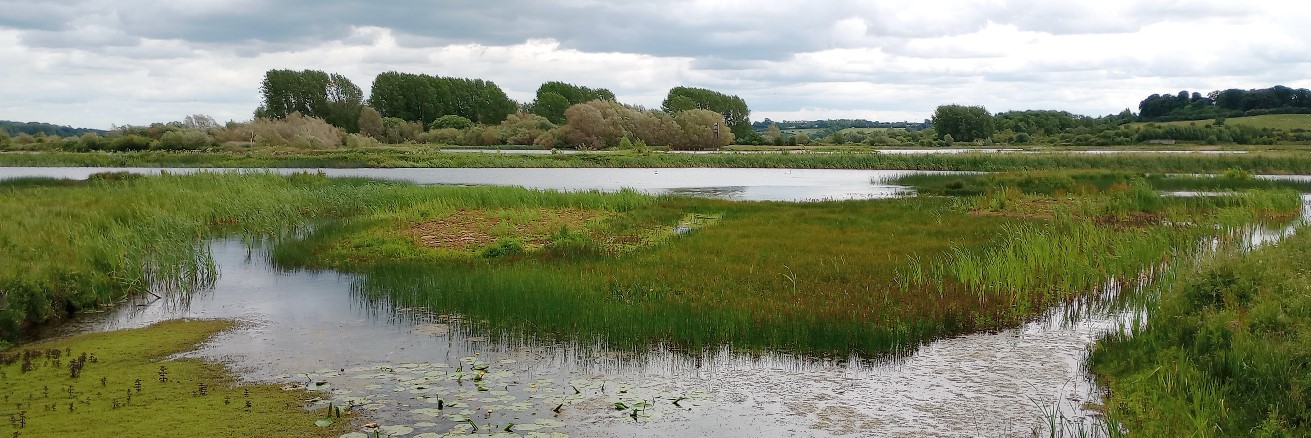
Wild places

NatureSpot features over 500 sites across Leicestershire and Rutland as Wild Places. These showcase many of the best places to see wildlife in our area. Each Wild Place page displays the records and images submitted for that location - which update automatically as additional records are received. A full species list for each site is also available.

Private Wild Places

By arrangement, we can set up Wild Place feature pages for private gardens, grounds, farms, estates and other areas without public access. These work just as any other Wild Place page except they are not included in the menus and maps and are only viewable using the private URL provided. We ask for a donation for setting up a private Wild Place - the amount is up to you! Get in touch if you are interested by emailing info@naturespot.org

New Wild Places?

If you know of a site with wildlife interest that could be featured as a Wild Place page then let us know. Wild Places should meet the following criteria:

  • must either be entirely in public access (such as a Country Park), or have a public right of way (PROW) through them or adjacent to them from which the site can be viewed OR the landowner has given consent for the land to become a Wild Place. (A PROW as defined by the Highways Authority: in Leicestershire; in Rutland). 
  • must consist largely of existing habitats of significance to wildlife - e.g. woodland, wetland, watercourse, heathland, open mosaic habitats, unimproved/semi-improved or species-rich grassland, parkland, orchard, scrubland.  Sites which consist mainly of arable and cultivated land or just improved grassland are not suitable as Wild Places. (See Leicestershire's Biodiversity Action Plan and the Leicestershire and Rutland Local Nature Recovery Strategy).

Please note that NatureSpot's designation of a site as a Wild Place does not confer any legal or protected status to the land, and has no weight within the planning system. Neither does it confer any additional public rights of use or access to the land.

Explore Wild Places

To explore the Wild Places of Leicestershire and Rutland:

  • zoom into the map and click on any site to show its details below
  • use the filters below to find sites in your district or parish
  • type any part of the site name to search for a particular site

Just click on APPLY when you have entered your selection. Alternatively you can browse the full list below.

Key: Wild Places (outlined in orange); Public Rights of Way (green); county boundaries (blue), parish boundaries (lilac)

Jubilee Park is a public recreation ground for the community of Thurcaston and Cropston and is situated on elevated ground overlooking the valley of the Rothley Brook.

This verge is now being managed to improve biodiversity as part of the County Council/Parish Council verges biodiversity trial. It was surveyed in June 22 by NatureSpot but we would welcome additional wildlife records from the community, whether plants, animals or fungi.

David Taylor Wood is a very small young woodland, planted with native broadleaf species: Wild Cherry, Oak, Hazel and Ash interspersed with Field Maple and Hawthorn.

This verge is being managed to improve biodiversity as part of the County Council/Parish Council verges biodiversity trial. It has been surveyed annually since 2021 by NatureSpot but we would welcome additional wildlife records from the community, whether plants, animals or fungi.

The site comprises three fields managed for wildlife, two of which are designated as Local Wildlife Sites because of their very rich floral diversity. Parts of the grassland are amongst the best meadows in Leicestershire. The fields are surrounded by mature, mixed species hedgerows and border the Rothley Brook on the north-east boundary where there are several mature Alders and Willows. A small wooded area and a pond are also part of the site. The meadow grassland is managed by grazing and sometimes by taking a hay cut.

This reserve is partly in Derbyshire and partly in Leicestershire, and is owned by Severn Trent Water and managed by the Wildlife Trust. It covers 23.5 ha and is part of a Site of Special Scientific Interest.

Created by Leicestershire County Council to provide a wildlife habitat and a greater area for visitors and local people to enjoy. The woodlands cover some 2.5 hectares. Over 6000 trees were planted including a variety of native trees and shrubs. The area is also criss-crossed with public footpaths. The project was funded by The National Forest Company.

The woodland park is managed by Leicestershire County Council on the site of the former Donisthorpe Colliery that closed in 1990. The site has been planted with oak/ash woodland, poplars and Corsican pine. Stone surfaced paths take you around the site and link with the towpath of the restored section of the Ashby Canal that leads to the Moira Furnace.

Donkey Lane in Sapcote is a short unmade road which runs from the Bassett Lane Cemetery for a few hundred yards.  The wide verges of lush vegetation and high hedges either side encourage a rich insect population typical of woodland edge, and at the end of the lane is a small copse with Aspen amongst other species.  Having reached the small copse area anyone wishing to extend their walk can follow public footpaths into the fields in two directions.

This small area of the playing fields is being rewilded by the Parish Council. 

This site is located directly adjacent to the main railway line which separates it from Beedles Lake Golf Course.  It forms the west boundary of Jubilee Playing Fields and provides a distinct contrast to the regular management and use of the sports pitches.  Since the railway sidings became disused  in the late 1960s, it has been allowed to re-wild.  Largely left un-managed, the site has naturally re-vegetated to create a mosaic of pioneer/early colonising species, succession species and scrub.

The Nature Garden occupies a small pocket of fairly level grassy land of about 500 m2 surrounded by houses. It appears to have been ‘left over’ at the end of the initial development of East Goscote. East Goscote is a modern village developed in the 1960s by Jelson Homes on the site of a WWII munitions factory. Recent research indicates that the plot might have been the site of a building dating from WWII which was used during the construction and then removed.

This verge is being managed to improve biodiversity as part of the County Council/Parish Council verges biodiversity trial. It was surveyed in 2021 by NatureSpot volunteers but we would welcome additional wildlife records from the community, whether plants, animals or fungi.

Edith Weston is a small village very close to the south side of Rutland Water. St Mary the Virgin church itself has an 'unusual' layout, which may be of interest, and the north arcade dates to the 12th century whilst the south aisle arcade is dated a little later to the early 13th century. The pretty churchyard is walled with a few mature trees.

The small village of Egleton is very near to Rutland Water and the Anglian Water Bird Watching Centre is accessed via the village. The church dates to the 12th century. The churchyard contains some matures trees and is sheltered from the adjacent road by a hedgerow.

Until 2015 this site was a piece of regularly mown amenity grassland which formed part of the former John Ellis School site (the school was demolished in the early 1990s).
The area was identified as part of a strategic flood alleviation scheme with works planned along the River Soar to improve flood storage during storm events.  Fortunately both the Environment Agency and City Council sought to implement blue-green techniques for flood storage rather than rely on traditional engineering methods that could have resulted in high walls and hard infrastructure.

This verge is being managed to improve biodiversity as part of the County Council/Parish Council verges biodiversity trial. It was surveyed in 2021 by NatureSpot volunteers but we would welcome additional wildlife records from the community, whether plants, animals or fungi.

Designated a Local Wildlife Site in 2003, Bloody Oaks verge covers an area of 2500m2, and is approximately 200 metres in length. It is located on Grantham Lane by the A1 on the northwestern side of the road only. The main habitats are calcareous grassland, mesotrophic grassland, and mixed grassland.

Empingham is a small village that lies just beyond the north east corner of Rutland Water, and the church itself is rather large in comparison. Much of the church dates to the 13th century, with some 15th century features and beyond. The churchyard is mostly open, with a few mature trees at the rear.

Designated a Local Wildlife Site in 2011, Empingham Estate roadside verge is approximately 160 metres in length, both sides of the drive. The habitat is made up of calcareous and mixed grassland, and mown in September.